
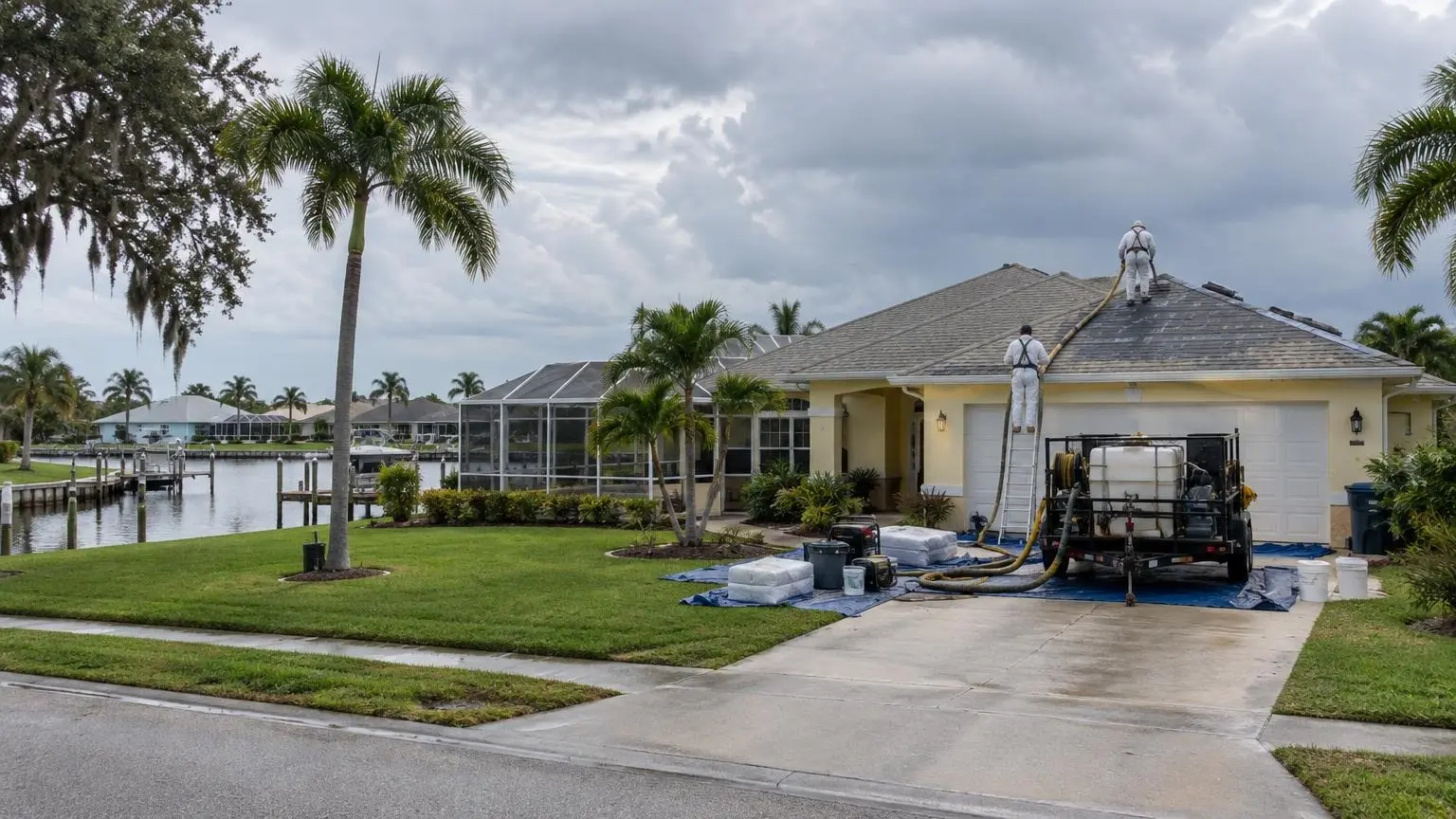
Open-cell and closed-cell foam
Spray Foam Insulation in Port Charlotte, FL
The right foam for each surface: open-cell under roof decks, closed-cell where water and steel are involved.
- Free on-site estimates
- Written quote listing foam type, thickness and R-value for each area
- Roof leaks and storm damage checked before anything is covered
Foam for Florida Heat
Spray foam insulation in Port Charlotte does its best work where the sun hits: the roof deck, the attic, and the walls of garages and metal buildings. Foam sprays on as a liquid, expands into every gap and cures in place, so a single layer insulates and stops air. That combination matters in a place where Wikipedia describes the summers as long, hot and humid, because air leaks carry humidity as well as heat. There are two foams, and choosing between them is the first step on every job.
Closed cell vs open cell
Open-cell foam is soft, light and expands roughly to fill a rafter bay in one pass. HomeGuide rates it at R-3.5 to R-3.7 per inch. It seals air extremely well and lets some water vapor pass. Closed-cell foam is dense, rigid and rated R-5 to R-7 per inch. At normal thickness it blocks vapor, resists water and adds strength to the surface it bonds to.
In Charlotte County those traits sort the work out. Open-cell is the usual pick for the underside of a roof deck, because it reaches the target R-value at a lower cost and, being vapor-open, does not trap water against the deck if a small leak develops. Closed-cell fits metal buildings, garage doors and walls, and anywhere water is likely to reach the insulation.
Why sealed attics are common here
In most Port Charlotte homes, the air handler and ductwork sit in the attic. On a summer afternoon that space can be far hotter than outdoors. Spraying foam under the roof deck and on the gable walls turns the attic into a semi-conditioned space, so the ducts run through mild air instead of extreme heat and duct leaks stay inside the house. The other route, sealing the ceiling and ducts and blowing more insulation on the floor, also works. We price both when both apply.
Code targets
The Insulation Institute's summary of Florida's 2023 energy code lists Climate Zone 2 targets of R-38 for ceilings, R-13 for wood-frame walls and R-6 or R-4 continuous for mass walls. Under a roof deck, the foam thickness is chosen to meet the ceiling target or the alternative allowed for that assembly, and we write the planned thickness and R-value on the quote.
Concrete block walls
Most homes here have concrete block exterior walls with furring strips and a thin layer of insulation behind the drywall. Those walls already meet a mass-wall standard and are rarely worth opening on their own. But during a remodel, an addition or storm repairs where drywall is off, spraying foam between the furring or framing adds R-value and seals air in a single step.
Where foam is not the answer
If the roof leaks, it gets fixed first. Foam does not stop a leak, and hiding one under insulation is the worst outcome. Foam also should not cover damaged or suspect wiring. On an attic floor that is easy to seal, blown-in insulation is usually the cheaper way to reach R-38 or more, and we say so.
Prep and cure
We cover floors and furniture, mask fixtures and set up ventilation before spraying. HomeGuide advises staying out of the house at least 24 hours while foam cures. Cured foam does not sag or settle, so the thickness we install stays put.
Tell us what you want fixed and we will look, explain where foam pays, and send a written price. Get a free estimate
Where We Spray Foam
The spots we foam most often around Port Charlotte, and the foam we usually choose.
Open-cell foam
Light foam at R-3.5 to R-3.7 per inch (HomeGuide); our usual choice under roof decks.
Closed-cell foam
Dense foam at R-5 to R-7 per inch that resists water; used on steel and in wet-prone walls.
Sealed attics
Foam on the roof deck and gables so ducts and the air handler sit in milder air.
Additions and remodels
Foam in open walls and ceilings before drywall goes back up.
Garages and workshops
Foam on walls, ceilings and roof decks of attached and detached garages.
Metal buildings
Closed-cell on steel roof and wall panels to cut heat and condensation.
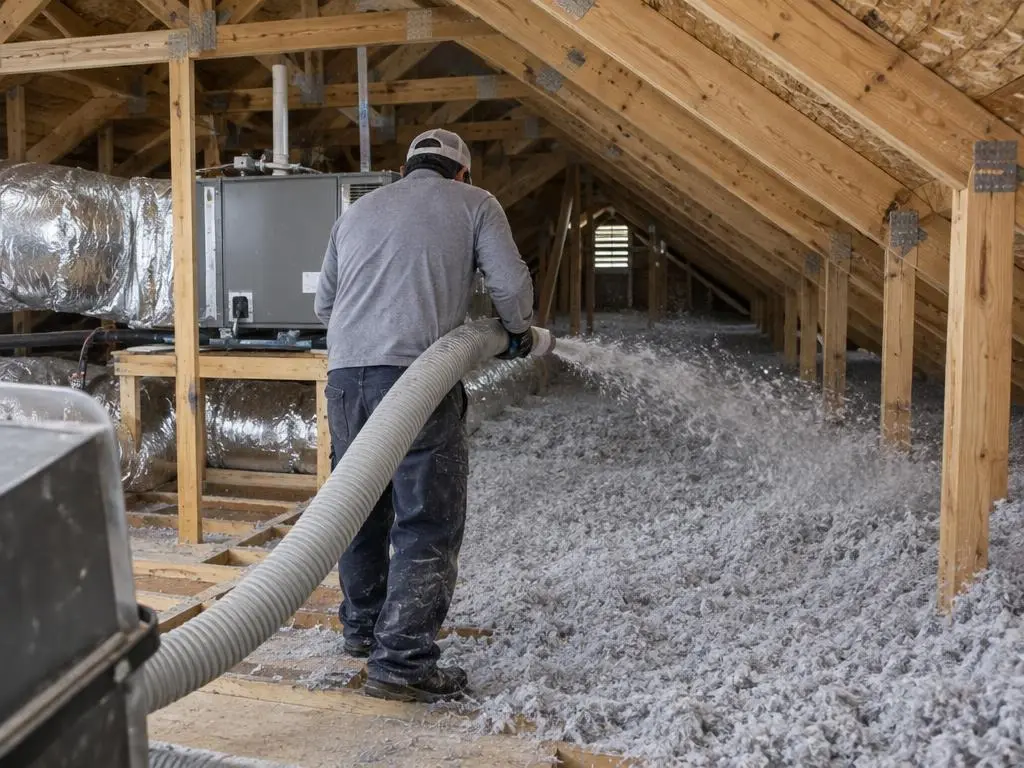
Published Spray Foam Insulation Costs
| Job | Range and source |
|---|---|
| Spray foam, installed | $1.50 to $5.00 per sq ft (HomeGuide) |
| Open-cell / closed-cell | $1.50 to $3.50 / $3.00 to $5.00 per sq ft (HomeGuide) |
| About 1,000 sq ft | $1,500 to $5,000 (HomeGuide); $3,150 to $7,500 existing home (Fixr) |
| Existing walls / new construction | $3.15 to $7.50 / $2.75 to $6.50 per sq ft (Fixr) |
| Whole house | $8,000 to $20,000 (HomeGuide); $10,000 to $30,000 (Fixr) |
| Typical job minimum | $1,000 to $2,000+ (HomeGuide) |
These come from HomeGuide's 2026 guide and Fixr's 2025 guide, both national. Roof pitch, access, foam type and thickness move your number, and small jobs can hit a minimum. The figure on your written estimate is the one you pay.
How a Spray Foam Job Runs
1. Visit
We inspect the attic, roof deck, ducts and any other space, and measure.
2. Written quote
Each area lists foam type, thickness, R-value and price.
3. Prep
Covering, masking and ventilation; HVAC plan confirmed for a sealed attic.
4. Spray
Foam goes on in passes to the planned thickness.
5. Walk-through
We clean up, show you the work and confirm when to return.
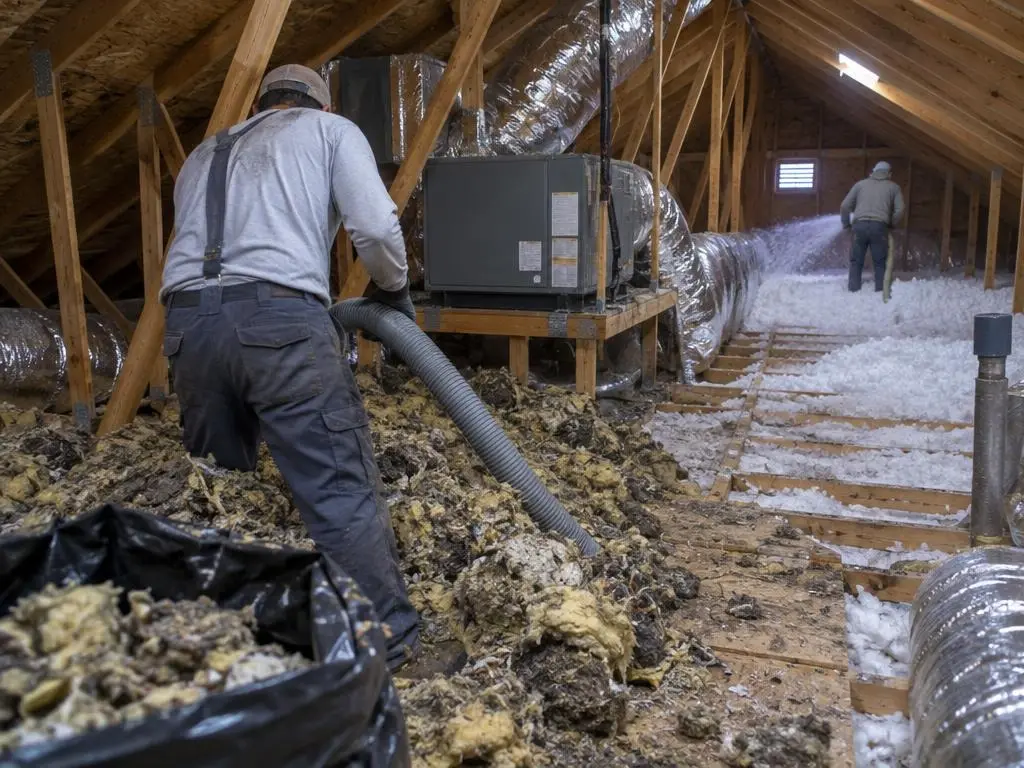
Why Choose Us for Spray Foam Insulation
Leaks found first
We check the deck for water stains and soft spots before spraying.
Thickness on paper
Planned thickness and R-value are on the quote so bids compare fairly.
Honest alternatives
If loose fill is the better buy for your attic, we say so.
Spray Foam Insulation Questions
Is open-cell or closed-cell better under a Florida roof?
Open-cell is the common choice under roof decks here because it reaches the target at lower cost and does not trap water against the deck. Closed-cell is used more on steel and in walls.
Does spray foam help with hurricanes?
Closed-cell foam adds some stiffness to what it bonds to, but it is not a substitute for roof straps, nailing or other code-required storm protection. We do not sell it as hurricane protection.
How long does the house need to be empty?
HomeGuide advises at least 24 hours while foam cures. We confirm timing for your job.
Will a sealed attic change my AC?
It can. The attic becomes part of the conditioned space, so the system should be checked by an HVAC contractor.
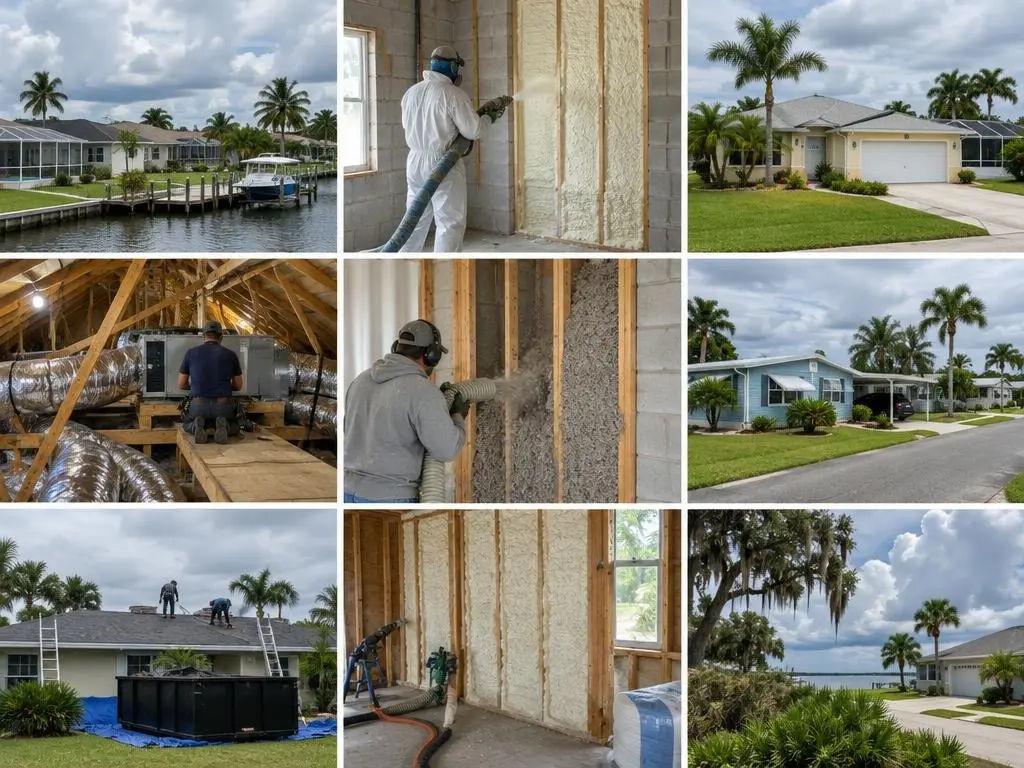
Spray Foam Insulation Service Areas
- Spray Foam Insulation in Port Charlotte, FL
- Spray Foam Insulation in Punta Gorda, FL
- Spray Foam Insulation in North Port, FL
- Spray Foam Insulation in Englewood, FL
- Spray Foam Insulation in Rotonda West, FL
- Spray Foam Insulation in Harbour Heights, FL
- Spray Foam Insulation in Babcock Ranch, FL
- Spray Foam Insulation in Venice, FL
- Spray Foam Insulation in Boca Grande, FL
- Spray Foam Insulation in North Fort Myers, FL
- Spray Foam Insulation in Arcadia, FL
- Spray Foam Insulation in Nokomis, FL
Get a Spray Foam Insulation Estimate
Tell us which spaces you are thinking about. We will look and send a written foam plan and price.