
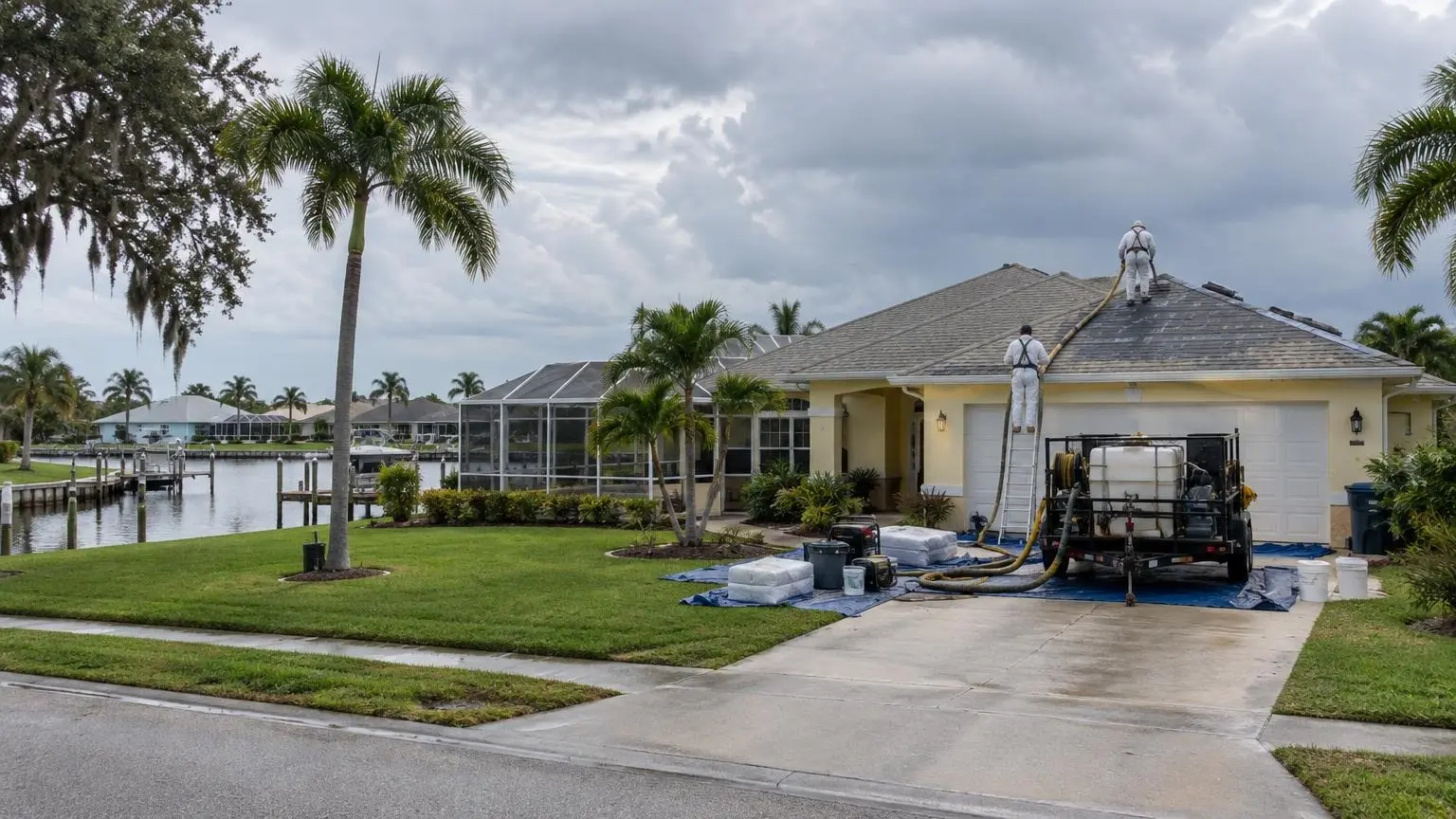
Block homes, attics and garages around Charlotte Harbor
Spray Foam Insulation in Port Charlotte, FL
Keep attic heat out of the house and your ductwork out of the heat, with every area priced in writing first.
- Free on-site estimates
- Written quote listing foam type, thickness and R-value for each area
- Roof leaks and storm damage checked before anything is covered
Insulation Built for a Gulf Coast Attic
Spray foam insulation in Port Charlotte is about one thing above all: the attic. Port Charlotte's climate, as Wikipedia describes it, is humid subtropical bordering on tropical, with long, hot, humid summers and frequent afternoon thunderstorms. Many homes here are single-story concrete block houses on slabs, so the walls and floor carry a lot of mass and the roof takes the full force of the sun. Heat pours through a thin or leaky attic floor all summer, and the air handler and ducts sitting in that attic work against it. We seal and insulate that space, with open-cell or closed-cell spray foam where it makes sense and blown-in insulation where it does the job for less.
What Florida's code asks for
The 2023 Florida Building Code, Energy Conservation, Eighth Edition, took effect on December 31, 2023. The Insulation Institute's summary of it lists Climate Zone 2 targets of R-38 for ceilings, R-13 for wood-frame walls, and R-6 (or R-4 continuous) for mass walls such as concrete block, with no slab insulation required. ENERGY STAR recommends R-49 for an uninsulated Zone 2 attic and an added R-38 where 3 to 4 inches are already down. Many attics in Charlotte County's 1970s and 1980s homes hold far less.
The homes we see here
General Development Corporation, run by the Mackle brothers, laid out Port Charlotte during the 1950s land boom, and the building came in waves after that. Census figures summarized by Point2Homes put Port Charlotte's median build year at 1983, with about 55% of homes from the 1970s and 1980s, and about 86% of all units are detached single-family houses. Many were built with modest attic insulation that has since been compressed, disturbed by HVAC and cable work, or damaged by roof leaks.
The storms have shaped the housing too. Category 4 Hurricane Charley struck in August 2004, and Wikipedia notes it destroyed almost half the homes in the county; in 2022 the eye of Hurricane Ian crossed southeastern Port Charlotte. A lot of roofs have been replaced since, and replacing a roof is one of the best moments to rethink the attic.
Closed cell vs open cell foam
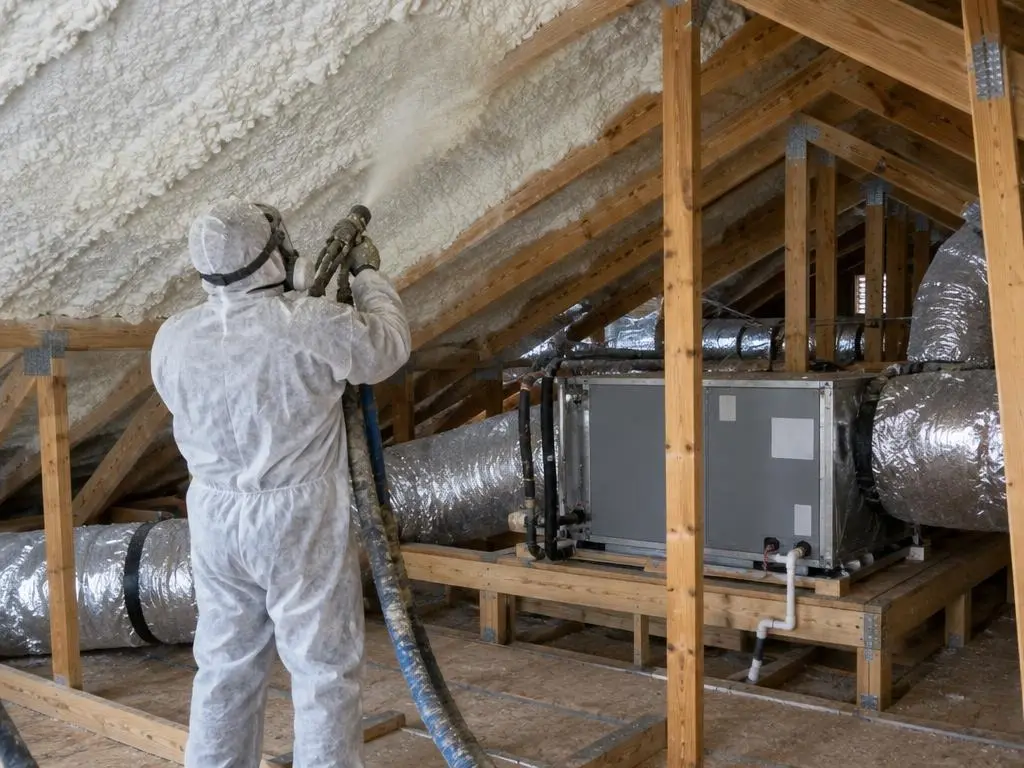
Open-cell foam is light and spongy, rated R-3.5 to R-3.7 per inch by HomeGuide. It expands to fill rafters and odd corners, seals air very well and is the usual choice for spraying the underside of a roof deck to create a sealed, conditioned attic. Water vapor can pass through it, which in a sealed attic lets the roof deck dry inward if a small leak ever develops, so leaks show up rather than hide. Closed-cell foam is dense and rigid, rated R-5 to R-7 per inch, resists water and adds strength to what it bonds to. It fits metal buildings, garage doors, walls in additions and places where moisture is a constant.
Foam is not always the best buy. On an open attic floor with the ducts in good shape, sealing the ceiling and blowing in fiberglass or cellulose to R-38 or R-49 often costs a fraction of a roof-deck foam job. We tell you when that is the case.
Spray foam insulation cost
HomeGuide's 2026 guide puts installed spray foam at $1.50 to $5.00 per square foot: open-cell $1.50 to $3.50, closed-cell $3.00 to $5.00. It lists foam on a roof deck at $1,500 to $9,000, an attic at $3,000 to $8,000, a whole house at $8,000 to $20,000, and a minimum charge of $1,000 to $2,000 or more at many companies. Blown-in insulation runs $1.00 to $2.80 per square foot in HomeGuide's blown-in guide. These are national ranges for planning. Roof pitch, attic access, foam thickness and how much old material has to come out set the real cost, and the written estimate after our visit is the price.
What to ask spray foam insulation contractors
When you call spray foam insulation contractors or insulation companies around Port Charlotte, ask a few things. Will they check the roof for leaks before spraying the deck? Which foam do they plan, at what thickness and R-value? Will the HVAC system be checked if the attic is sealed? How long will the house need to be empty (HomeGuide advises at least 24 hours)? Is the price broken out by area? A clear answer to each is a good sign. Our quotes cover all of them in writing.
FPL rebates
FPL lists a ceiling insulation rebate for customers whose existing ceiling insulation is below R-8, installed through an FPL participating contractor, and it offers a free home energy analysis to see whether a home qualifies. Check FPL's current terms before work starts.
Seasonal homes
The 2020 census counted 29,998 housing units in Port Charlotte, 13.3% of them vacant, and many of those belong to winter residents. A house closed up all summer still heats up under the roof and can grow musty if humidity is not controlled. Sealing the attic and keeping the AC set to manage humidity is a common plan for part-year owners.
Towns We Cover Around Charlotte Harbor
We work in Port Charlotte and around the harbor: Punta Gorda and Harbour Heights across the Peace River; North Port, Venice and Nokomis to the north; Englewood, Rotonda West and Boca Grande toward the Gulf; Babcock Ranch and North Fort Myers to the south; and Arcadia up the Peace River in DeSoto County. Canal towns like Punta Gorda Isles and Englewood deal with low ground and storm surge. Newer towns like Babcock Ranch and much of North Port have newer homes built to tighter standards. Each town page covers what is different there.
- Spray Foam Insulation in Port Charlotte, FL
- Spray Foam Insulation in Punta Gorda, FL
- Spray Foam Insulation in North Port, FL
- Spray Foam Insulation in Englewood, FL
- Spray Foam Insulation in Rotonda West, FL
- Spray Foam Insulation in Harbour Heights, FL
- Spray Foam Insulation in Babcock Ranch, FL
- Spray Foam Insulation in Venice, FL
- Spray Foam Insulation in Boca Grande, FL
- Spray Foam Insulation in North Fort Myers, FL
- Spray Foam Insulation in Arcadia, FL
- Spray Foam Insulation in Nokomis, FL
What We Do
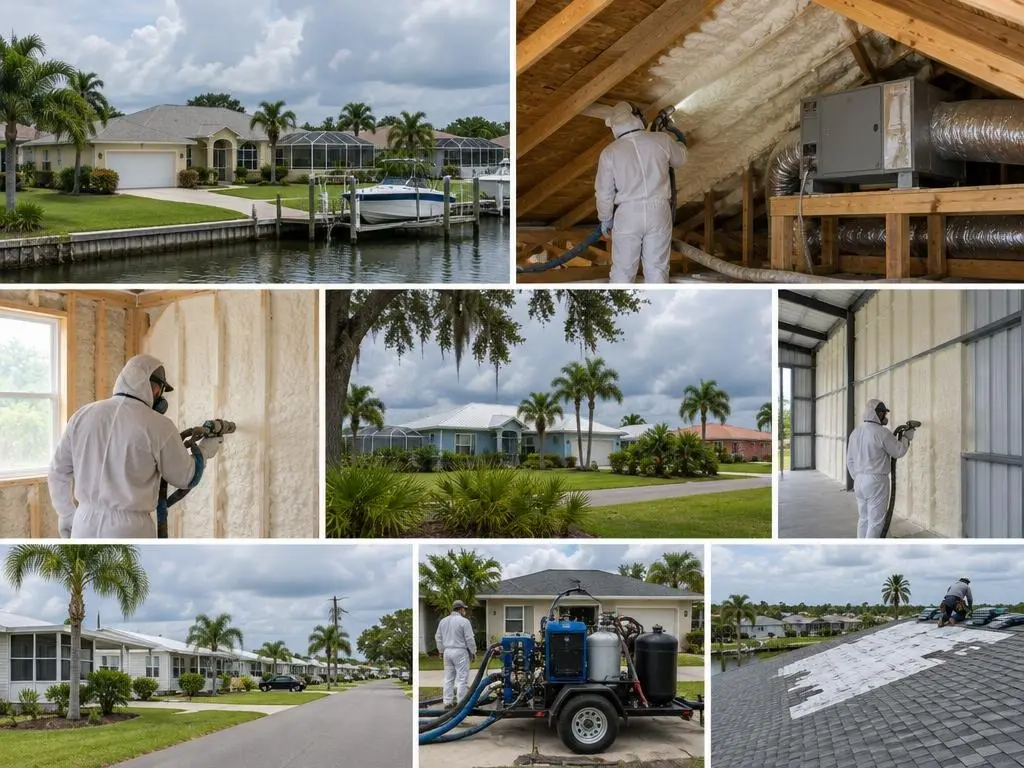
Six kinds of insulation work, matched to each part of a Charlotte County house, from foam under the roof deck to clearing out storm-soaked attic fill.
Spray Foam Insulation
Open-cell and closed-cell foam that insulates and air seals in one pass, for roof decks, walls, garages and metal buildings.
Learn more →Sealed Attic & Roof Deck Foam
Open-cell foam under the roof deck that brings a hot attic, and the ducts inside it, into the cooled space.
Learn more →Blown-In Attic Insulation
Fiberglass or cellulose blown over a sealed ceiling to bring the attic floor to R-38 or more.
Learn more →Insulation Removal & Replacement
Clearing out storm-soaked, crushed or rodent-soiled insulation and reinsulating the attic properly.
Learn more →Block & Frame Wall Insulation
Foam and dense-pack insulation for block walls, frame additions and walls opened during remodels or storm repairs.
Learn more →Garage & Metal Building Insulation
Foam for garages, workshops and steel buildings that bake by noon and sweat when the AC kicks on.
Learn more →Common Questions
How much should I expect to pay for spray foam insulation?
HomeGuide's 2026 guide lists $1.50 to $5.00 per square foot installed, with foam on a roof deck at $1,500 to $9,000 and an attic at $3,000 to $8,000. Your price depends on roof size, pitch, access and thickness, and the written estimate after our visit is what you pay.
How much does it cost to spray foam 2,000 square feet?
Using HomeGuide's per-square-foot ranges, 2,000 square feet of open-cell would fall around $3,000 to $7,000 and closed-cell around $6,000 to $10,000 before access and prep. Note that a roof deck has more square footage than the floor below it because of the pitch. We measure and quote the real area.
Is there a downside to spray foam insulation?
It costs more than loose fill, it is hard to remove, and it needs the house empty for about a day while it cures. A sealed attic also changes how the HVAC system handles humidity, so the system should be checked. Where those trade-offs do not pay off, we recommend something else.
How much does spray foam insulation cost in Florida?
We use national figures: HomeGuide lists open-cell at $1.50 to $3.50 and closed-cell at $3.00 to $5.00 per square foot installed. Florida jobs are most often open-cell on the roof deck. The written estimate for your house is the actual price.
What R-value does a Port Charlotte attic need?
The Insulation Institute's summary of Florida's 2023 energy code lists R-38 for ceilings in Climate Zone 2. ENERGY STAR suggests R-49 for an uninsulated Zone 2 attic. We measure what you have and quote the depth needed.
Should I insulate when I replace my roof?
It is a good time to look. Roof-deck foam can be sprayed after the new roof is on, and the roofer can confirm the deck is sound. Let us see the attic before or right after the roof work.
Why Homeowners Call Spray Foam Insulation Port Charlotte
We see it before we price it
Every quote follows a visit to the attic and any other space you want done.
Roof and leaks checked first
Wet decking and old storm damage get flagged before foam goes on.
Foam only where it pays
If blown-in over a sealed ceiling reaches the target for less, that is what we recommend.
Numbers you can compare
Each area on the quote shows material, thickness or depth, R-value and price.
Get a Written Insulation Quote in Port Charlotte
We come out, check the attic and roof deck, and send a written price with the material and R-value for each area.